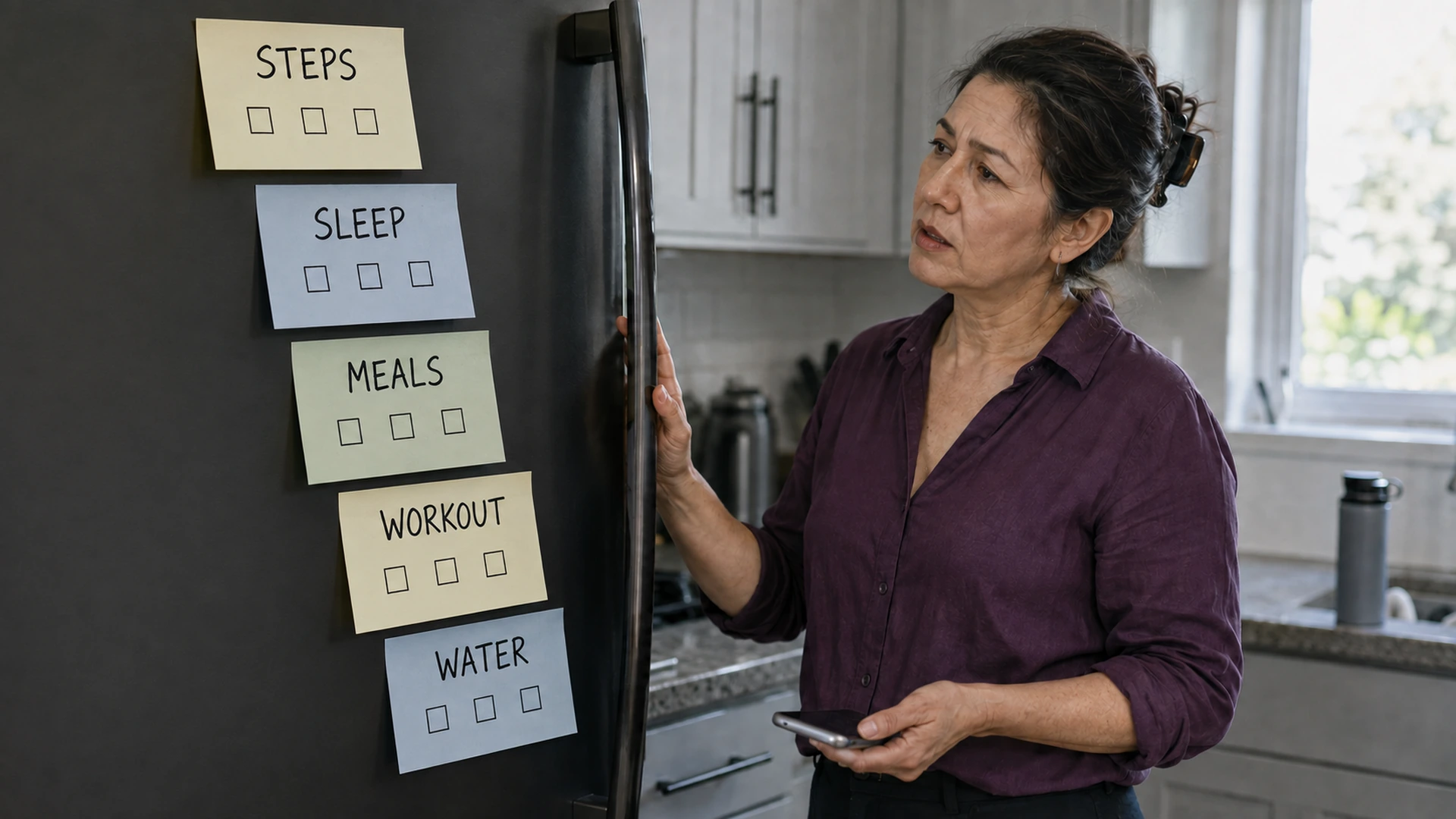
Sometimes a person looks at their first antioxidant score and goes quiet.
They may have expected the number to be higher because they eat vegetables, drink juice, take supplements or made several healthier choices recently. When the result does not match that expectation, it can feel personal.
This is what I remind them:
"This is your starting point, not a judgment of your health."
A PRYSM Score estimates carotenoids in the skin. It can provide a useful baseline and something to follow over time, but it does not grade your whole diet or decide whether you are healthy.
The most helpful response is not to defend the number or fear it. It is to understand what it can tell you, choose one realistic habit and use future readings as context rather than a competition.
Why can the first score feel surprising?
Most of us remember our intentions and our best choices more clearly than the ordinary pattern in between.
You may remember the salad you ate yesterday but not the three rushed lunches earlier in the week. You may eat vegetables regularly at dinner while having little fruit or vegetable variety during the rest of the day. Perhaps you started changing your routine only recently and expected the result to reflect that effort immediately.
None of this means you were dishonest or that your effort did not count. It means human memory is not a perfect food record, and one scan is not a complete history.
Skin carotenoid readings are associated with carotenoid status and fruit and vegetable intake, but the relationship is not one-to-one. A systematic review found that spectroscopy-based skin measurements can be useful as a non-invasive biomarker while also noting that more research is needed before treating them as equivalent to blood carotenoid tests or validated dietary assessment tools.
That is why the number needs context.
What does PRYSM actually estimate?
PRYSM iO uses an optical finger scan to estimate carotenoids in the skin and converts the reading into a PRYSM Score.
Carotenoids are a family of plant pigments found in foods such as carrots, pumpkin, tomatoes, leafy greens, papaya and peppers. Some carotenoids accumulate in the skin, which makes optical measurement possible.
The score does not diagnose oxidative stress, a nutrient deficiency or disease. It cannot identify exactly what you ate, and it does not replace blood tests or medical assessment.
Think of it as one visible marker connected to part of your food pattern. It is one dashboard light, not the entire dashboard.
Why one reading should not become a report card
When a number is presented on a scale, people naturally want to label it as good or bad. They may also compare it with a friend, partner or colleague.
That comparison is rarely the most useful one.
Skin carotenoid readings may be influenced by dietary patterns and individual factors. Measurement conditions and correct finger placement also matter. Two people can follow different routines and begin from different baselines.
The better comparison is usually your own reading over time, taken under reasonably consistent conditions and interpreted alongside your actual habits.
This shift changes the conversation. Instead of asking, "Why is my number worse than theirs?" you can ask, "What does my starting point help me notice?"
Step 1: Stay calm and keep the number in context
An unexpected score is information, not a diagnosis.
Avoid making a large dietary or supplement change based on one result. Do not assume a lower-than-expected number proves that your diet is poor or that your health is at risk. Equally, a higher number does not prove that every part of your lifestyle is ideal.
Your sleep, strength, movement, medical history, food adequacy, stress and many other aspects of health are outside what this scan measures.
Begin by accepting the baseline without turning it into a label.
Step 2: Choose one repeatable food habit
The score becomes useful when it helps you notice a practical opportunity.
Look at your normal week rather than trying to create a perfect antioxidant menu. Where is the easiest opening?
You might:
- add one fruit to a breakfast you already eat;
- include a vegetable choice with your usual lunch;
- keep frozen vegetables for rushed dinners;
- rotate two or three colourful plant foods instead of relying on one;
- attach a produce choice to a routine that already happens;
- consider an appropriate supplement as additional antioxidant support when it fits your needs and routine.
Choose one action you can repeat. A dramatic three-day effort is less informative than a routine that has time to become normal.
This is not about chasing the highest possible score. It is about using feedback to support a wider, more consistent food pattern.
Step 3: Follow your own trend consistently
If you rescan, follow the device instructions and try to keep the process reasonably consistent. Correct finger placement, device use and measurement conditions help make comparisons more meaningful.
Do not promise yourself that a particular food, juice or supplement will produce a specific increase by a deadline. Individual responses vary, and the score reflects more than one recent meal.
When the next result appears, review it together with the habit you actually followed. If the number changes, treat that as one piece of information. If it does not, avoid declaring the effort a failure. Consider the duration, consistency, wider food pattern and limits of the measurement.
What I want people to take away
The most valuable part of a PRYSM scan is not receiving a number. It is having a clearer conversation about habits that are usually difficult to see.
An unexpected result can create disappointment, or it can create curiosity. I prefer curiosity.
Your first score is a baseline. It does not erase the positive choices you already make, and it does not define your health. Use it to choose one small experiment, then watch your own pattern with patience and context.
If you would like to know your PRYSM Score, contact Vern Lai for a finger scan and a calm discussion of what the result may mean within your everyday routine.
This article provides general wellness education and is not a medical or nutritional diagnosis.
- Radtke MD, et al. “Criterion-Related Validity of Spectroscopy-Based Skin Carotenoid Measurements as a Proxy for Fruit and Vegetable Intake: A Systematic Review.” Advances in Nutrition, 2020. https://pubmed.ncbi.nlm.nih.gov/32407509/
- Ahn S, et al. “Validation of resonance Raman spectroscopy-measured skin carotenoid status as a biomarker for fruit and vegetable intake in Korean adults.” British Journal of Nutrition, 2023. https://pubmed.ncbi.nlm.nih.gov/37184085/
- Riggs M, et al. “Validation of a New Non-invasive Personalized RS-Skin Carotenoid Scanner (Prysm iO) versus the BioPhotonic Scanner S3 RRS Device for Estimating Carotenoid Levels in Humans.” Food & Nutrition Journal, 2026. Funded by NSE Products, Inc. https://www.gavinpublishers.com/article/view/validation-of-a-new-noninvasive-personalized-rsskin-carotenoid-scanner-prysm-io-versus-the-biophotonic-scanner-s3-rrs-device-for-estimating-carotenoid-levels-in-humans
- Nu Skin. “Prysm iO Consumer Edition.” https://www.nuskin.com/us/en/product/prysm-io-consumer-edition