Air fryers have become a favourite kitchen tool because they make food crispy with less oil.
That sounds like a win, especially if you are trying to eat lighter or reduce deep-fried foods.
But here is the part many people miss:
**Less oil does not automatically mean healthier if the food is repeatedly cooked at very high heat until it becomes too brown, dry, or charred.**
The air fryer itself is not the problem. The bigger issue is how often you use it, what you put inside, and how far you push the cooking time.
Why Air-Fried Food Tastes So Good
That golden colour and crispy smell come from a natural browning process called the Maillard reaction.
This happens when proteins and sugars in food react under heat. It gives roasted, grilled, baked, and air-fried foods their flavour, colour, and crunch.
That is why toast, roasted potatoes, grilled chicken, tofu cubes, and crispy snacks can taste so satisfying.
But when heat is too high, or cooking time is too long, food can move from golden and crisp to dark brown, dry, or burnt.
That is where the concern begins.
The Main Concern Is High-Heat Cooking
High-heat cooking can create certain compounds, especially when food is cooked until very brown or charred.
For starchy foods like potatoes, bread, toast, sweet potatoes, biscuits, and chips, one compound often discussed is **acrylamide**. The FDA explains that acrylamide can form in some plant-based foods during high-temperature cooking such as frying, roasting, and baking.
For meat, especially when cooked at high heat until very browned or charred, compounds such as **HCAs** and **PAHs** may form. The National Cancer Institute explains that these compounds can form when muscle meats are cooked using high-temperature methods.
This does not mean one air-fried meal is dangerous.
It means we should avoid turning every meal into a very high-heat, extra-crispy meal.
Air Fryer Does Not Mean "Unlimited Healthy"
A common mistake is thinking:
"I used an air fryer, so this is automatically healthy."
But air-fried chicken nuggets, fries, fish fingers, hash browns, frozen snacks, and reheated fried foods are still often processed, salty, or calorie-dense.
The air fryer can reduce added oil compared with deep frying, but it does not turn every food into a balanced meal.
A better question is:
**Am I using the air fryer to make real food easier, or am I using it to eat more crispy processed food every day?**
That question is more useful than asking whether the air fryer is good or bad.
6 Safer Ways To Use Your Air Fryer
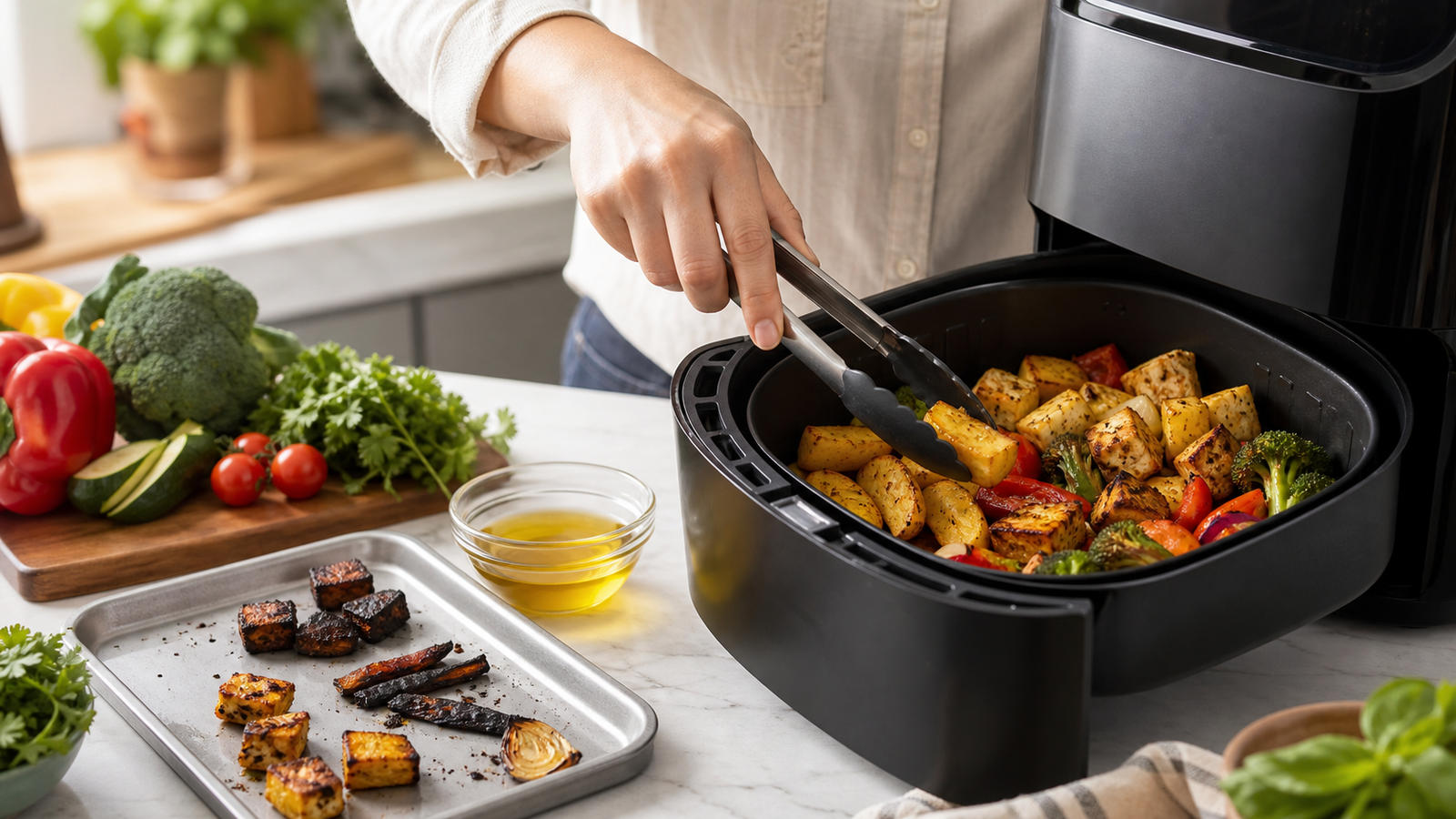
1. Stop at golden, not burnt
Aim for light golden brown instead of dark brown or charred.
If food smells burnt or has blackened parts, trim those off and reduce the cooking time next round.
2. Do not rely on the air fryer for every meal
Rotate your cooking methods.
Use steaming, boiling, stewing, soup, stir-frying with less oil, baking, and simple rice-cooker meals too.
Your body benefits from variety, not just one "healthy" appliance.
3. Pre-cook thick foods first
For thick potatoes, sweet potatoes, pumpkin, or larger meat pieces, consider steaming, microwaving, or partially cooking them first.
Then use the air fryer briefly for colour and texture.
This can reduce the time spent under high heat.
4. Be careful with frozen processed foods
Frozen nuggets, fries, hash browns, and breaded snacks are convenient, but they are not automatically everyday health foods.
Use them occasionally, and pair them with vegetables, protein, and a proper meal structure.
5. Clean the basket after each use
Burnt crumbs, oil residue, and blackened bits can keep heating again and again.
Cleaning the basket and tray helps reduce smoke, burnt smells, and old residue sticking to the next batch of food.
6. Reheat gently
If you are reheating yesterday’s fried food, you do not need to make it "freshly crispy" again.
Warm it through. Avoid repeated long heating just to chase the crunch.
The Bottom Line
The air fryer can be useful.
It can help you cook faster, use less oil, and make vegetables, tofu, chicken, fish, potatoes, and leftovers more enjoyable.
But it should be one cooking tool, not the only cooking method.
The healthier approach is not "never use oil" or "air fry everything".
It is:
**Cook real food more often. Avoid burning or charring. Use different cooking methods. Keep meals balanced.**
If you want a simple place to begin, focus on your usual meal pattern first.
Protein, fibre, vegetables, enough food, and realistic routines matter more than chasing the "perfect" appliance.
If you want a simple guide to build more balanced everyday meals, start here: https://vernlai.com/reset
- Cava article used as source context: https://cava.tw/fitness/healthcare/266340
- FDA: Acrylamide and Diet, Food Storage, and Food Preparation. https://www.fda.gov/food/process-contaminants-food/acrylamide-and-diet-food-storage-and-food-preparation
- FDA: Survey Data on Acrylamide in Food. https://www.fda.gov/food/process-contaminants-food/survey-data-acrylamide-food
- National Cancer Institute: Chemicals in Meat Cooked at High Temperatures and Cancer Risk. https://www.cancer.gov/about-cancer/causes-prevention/risk/diet/cooked-meats-fact-sheet
- Health Canada: Acrylamide in Food. https://www.canada.ca/en/health-canada/services/food-nutrition/food-safety/chemical-contaminants/food-processing-induced-chemicals/acrylamide.html