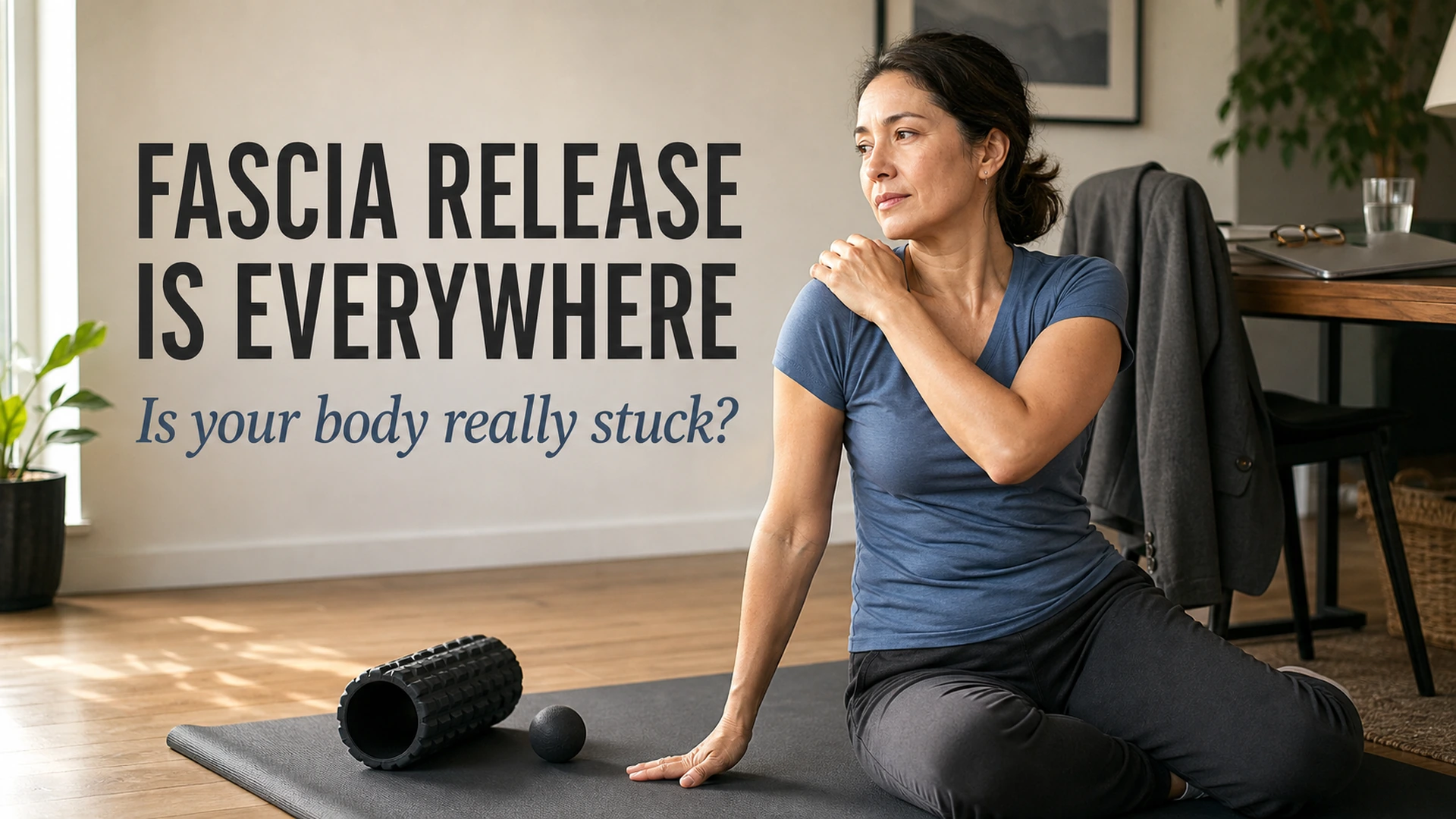
You roll your shoulders, pull one arm across your chest, stretch your neck from side to side – and ten minutes later, the tight feeling is back.
That does not necessarily mean you stretched incorrectly. Shoulder tightness is not always caused by one short muscle that simply needs a longer stretch. Long periods in the same position, repeated desk work, stress, limited movement variety and reduced shoulder strength or endurance can all be part of the picture.
Stretching may provide temporary comfort. But if your shoulders keep tightening again, the more useful question may be: what keeps asking them to work this way all day?
Why can stretching feel good but not last?
Stretching changes the sensation around a muscle and joint for a while. It can also give you a welcome pause from the position you have been holding.
But consider what happens during a typical workday. You may spend hours reaching towards a keyboard, holding a phone, looking at a screen or lifting your shoulders slightly when concentrating. A short stretch does not remove the next three hours of the same workload.
This is why a stretch can be useful without being the complete answer. Research involving office workers suggests that exercise can help with non-specific neck and shoulder discomfort, with strengthening showing promise alongside stretching and other movement approaches. The certainty of the evidence varies, so there is no single routine that works for everyone.
The practical lesson is simple: do not ask one stretch to solve an entire day of repeated positions.
Are you holding one position for too long?
People often search for the perfect posture. In reality, even a posture that looks "correct" can become uncomfortable when it is held for a long time.
Your body generally benefits from changing positions. Sitting back for a while, standing up, walking to refill your water, moving your arms and adjusting your screen or chair can all reduce the amount of time spent in one fixed pattern.
This does not require a complicated ergonomic makeover. Start by noticing:
- Do your forearms have somewhere comfortable to rest?
- Are you repeatedly reaching for your mouse?
- Do you raise one shoulder while using your phone?
- Does your screen make you turn or lean in one direction?
- How long passes before you change position?
The aim is not perfect posture. It is more movement variety across the day.
Stress can change how your shoulders feel
Shoulder tension is not "all in your head," but mental load can affect the way you hold your body.
When you are rushing, concentrating or worried, you may grip the mouse, clench your jaw, breathe more shallowly or lift your shoulders without noticing. Stretching the area may feel pleasant, but the tension can return when the same work pressure returns.
Try pairing movement with a brief downshift. Let your arms hang comfortably, unclench your hands, breathe out slowly and allow your shoulders to settle. The goal is not to force them down. It is to notice whether you are carrying effort that the task does not require.
Your shoulders may need capacity, not only flexibility
If your daily routine asks your neck, shoulder and upper-body muscles to support you for hours, those muscles may also benefit from appropriate strength and endurance work.
Systematic reviews of office workers with neck discomfort have found that neck- and shoulder-focused strengthening can reduce pain for some people, although the evidence is not perfect and exercise should suit the individual.
That does not mean jumping into a hard workout when you are already sore. It may mean gradually including comfortable pulling, pushing and shoulder-control movements in your week. A physiotherapist or qualified exercise professional can help if you are unsure what is appropriate, especially when symptoms keep returning.
Stretching and strengthening are not competitors. One may help you move comfortably today, while the other may help build capacity for what you repeatedly ask your body to do.
What about traditional pressure points?
Traditional East Asian practices describe pressure points around the neck and shoulder region, including Fengchi (GB20) near the base of the skull and Jianjing (GB21) across the upper shoulder area.
Some people use gentle fingertip pressure around these points as part of a relaxation routine. A systematic review of acupressure for uncomplicated stiff-neck symptoms found potentially positive results, but the included studies were limited and varied considerably. That means pressure-point massage may feel comforting, but it should not be presented as a proven cure or as a way to diagnose the cause of stiffness.
If you explore acupressure, keep the pressure gentle and stop if it causes pain, dizziness, tingling or other unusual symptoms. It should feel like a calm self-care practice, not a test of how much pressure you can tolerate.
Where can shoulder massage fit?
Massage can be another way to create a pause, bring attention to the area and help the shoulders feel more relaxed. Evidence for massage as a treatment for neck pain remains uncertain, but many people still value the immediate comfort and sense of unwinding it can provide.
WellSpa iO is one option that combines shaped massage nodes with adaptive microcurrent. Used with its Body Activating Gel and guided shoulder routine, it is designed to provide a smooth, comfortable massage while contributing to skin stimulation and relaxation.
Think of it as part of the relaxation layer: a few quiet minutes to slow down, notice the shoulder area and transition out of a demanding workday. It does not replace movement, strength, sleep, recovery or professional assessment when those are needed.
If you are curious about experiencing a guided WellSpa shoulder-relaxation session, contact Vern Lai to find out more.
Try this practical shoulder reset
Instead of relying on one long stretch at the end of the day, experiment with a broader reset:
1. Change position before discomfort builds up.
2. Move your shoulders and arms through a comfortable range.
3. Use a gentle stretch if it feels helpful, without forcing the end position.
4. Add suitable shoulder-strengthening work gradually across the week.
5. Use breathing, fingertip pressure or shoulder massage as a relaxation option.
6. Review the work habit that makes the tightness return.
You do not have to complete every step at once. Pick the one your routine is currently missing.
When should you get the discomfort checked?
General self-care is not suitable for every type of neck or shoulder symptom.
Seek medical advice if the discomfort follows an injury, keeps worsening, lasts for several weeks or is accompanied by symptoms such as pins and needles, weakness, numbness, a cold arm, severe headache, fever, dizziness or pain travelling down the arm. Sudden or severe symptoms need timely assessment.
The takeaway
If your shoulders still feel tight after stretching, it does not automatically mean you need a stronger stretch. Your body may be responding to repeated positions, workload, stress, limited movement variety or a need for more strength and recovery.
Stretching can remain part of the routine. Just give it some support: move more often, build capacity gradually and use relaxation tools as relaxation tools.
This article provides general wellness education and is not a diagnosis or treatment plan.
- NHS. “Neck pain and stiff neck.” https://www.nhs.uk/symptoms/neck-pain-and-stiff-neck/
- Chen X, et al. “Effectiveness of exercise in office workers with neck pain: A systematic review and meta-analysis.” South African Journal of Physiotherapy, 2018. https://pmc.ncbi.nlm.nih.gov/articles/PMC6093121/
- Govaerts R, et al. “The influence of exercise on pain, disability and quality of life in office workers with chronic neck pain: A systematic review and meta-analysis.” 2024. https://pubmed.ncbi.nlm.nih.gov/38219373/
- Lee IS, et al. “Clinical effects of acupressure on neck pain syndrome: A systematic review.” Integrative Medicine Research, 2018. https://pmc.ncbi.nlm.nih.gov/articles/PMC6160503/
- Cochrane. “Massage for neck pain.” 2024. https://www.cochrane.org/evidence/CD004871_massage-neck-pain
- Nu Skin. “ageLOC WellSpa iO Product Information Page.” https://www.nuskin.com/content/dam/office/pacific_new/shared/en/pips/skincaredevices/ageLOC-WellSpa-iO-PIP.pdf