You buy colourful vegetables because you want the nutrients. Then you boil, steam, roast, or stir-fry them and wonder: did the heat just destroy everything useful?
The short answer is no. Cooking does not simply remove all antioxidants, and raw vegetables are not automatically more nutritious. The result depends on the vegetable, the nutrient, the cooking method, how much water is used, and how long the food is heated.
Some heat-sensitive nutrients, particularly vitamin C, can decrease during cooking. At the same time, heat can soften plant structures and make certain carotenoids easier for the body to access. The most practical approach is not to choose one side. It is to eat a variety of vegetables, use different preparation methods, and avoid routinely overcooking them.
Why “raw versus cooked” is the wrong argument
Vegetables contain many different compounds. Vitamin C behaves differently from beta-carotene. Lycopene behaves differently from folate. A cooking method that preserves one nutrient well may reduce another.
There is also a difference between how much of a compound remains in the food and how much your body can absorb. A laboratory may measure a lower quantity after cooking, yet the softened food structure may make part of what remains more accessible during digestion.
That is why simple claims such as “heat destroys nutrients” or “cooked vegetables are healthier” miss the bigger picture.
What happens to vitamin C when vegetables are cooked?
Vitamin C is water-soluble and sensitive to heat. When vegetables are boiled in a large amount of water, some vitamin C can break down or move into the cooking liquid.
Research comparing common preparation methods has found that vitamin C retention varies widely by vegetable and technique. In one study, microwaving generally retained more vitamin C than boiling. A broccoli study found that steaming caused little measurable vitamin C loss under the tested conditions, while boiling and combined stir-frying followed by boiling produced larger losses.
This does not make boiled vegetables “empty.” They still provide fibre and other nutrients. If the cooking liquid becomes part of a soup or stew, some water-soluble nutrients that moved into the liquid may still be eaten.
The practical lesson is simple: when suitable, use less water, avoid cooking vegetables much longer than necessary, and include the broth when it belongs in the dish.
Can cooking make carotenoids easier to absorb?
Carotenoids are plant pigments found in foods such as carrots, tomatoes, pumpkin, leafy greens, papaya, and red or yellow peppers. They include beta-carotene, lycopene, lutein, and zeaxanthin.
These compounds sit within plant-cell structures. Chopping, pureeing, and heating can disrupt that structure, which may help release carotenoids during digestion. Human research on carrots has shown greater beta-carotene bioavailability from cooked or processed carrot meals than from raw chopped carrots under the study conditions.
Carotenoids are also fat-soluble. Eating carotenoid-rich vegetables as part of a meal containing some dietary fat, such as tofu, eggs, fish, nuts, seeds, avocado, or cooking oil, may support absorption.
This does not mean that every vegetable should be cooked heavily or covered in oil. It means the food matrix and the complete meal matter, not just the nutrient number on paper.
Which cooking method protects antioxidants best?
There is no universal winner, but these are useful starting points:
- Steaming can limit direct contact with water and often performs well for delicate vegetables.
- Microwaving with little added water can be a quick, nutrient-conscious option.
- Quick stir-frying can soften vegetables without the long heating time of slow boiling.
- Roasting can make vegetables enjoyable and convenient, although very high heat and long cooking times may reduce some heat-sensitive compounds.
- Boiling can cause water-soluble nutrients to move into the water, but soups and stews allow you to consume that liquid.
Cooking method is only one part of the decision. A vegetable prepared in a way that you enjoy and eat regularly may be more useful than a theoretically “perfect” preparation you avoid.
What about bacteria and germs on raw vegetables?
Nutrition is only one side of the raw-versus-cooked discussion. Raw produce can be contaminated by soil, irrigation water, storage, handling, or contact with raw meat and seafood. Harmful bacteria, viruses, and occasionally parasites may be present even when the vegetable looks fresh.
Washing helps reduce surface dirt and some microbes, but it does not sterilise produce. Cooking thoroughly provides a stronger reduction in harmful microorganisms.
This does not mean every salad is dangerous. It means raw vegetables need sensible handling:
1. Wash your hands before preparing food.
2. Remove damaged, bruised, or rotting portions.
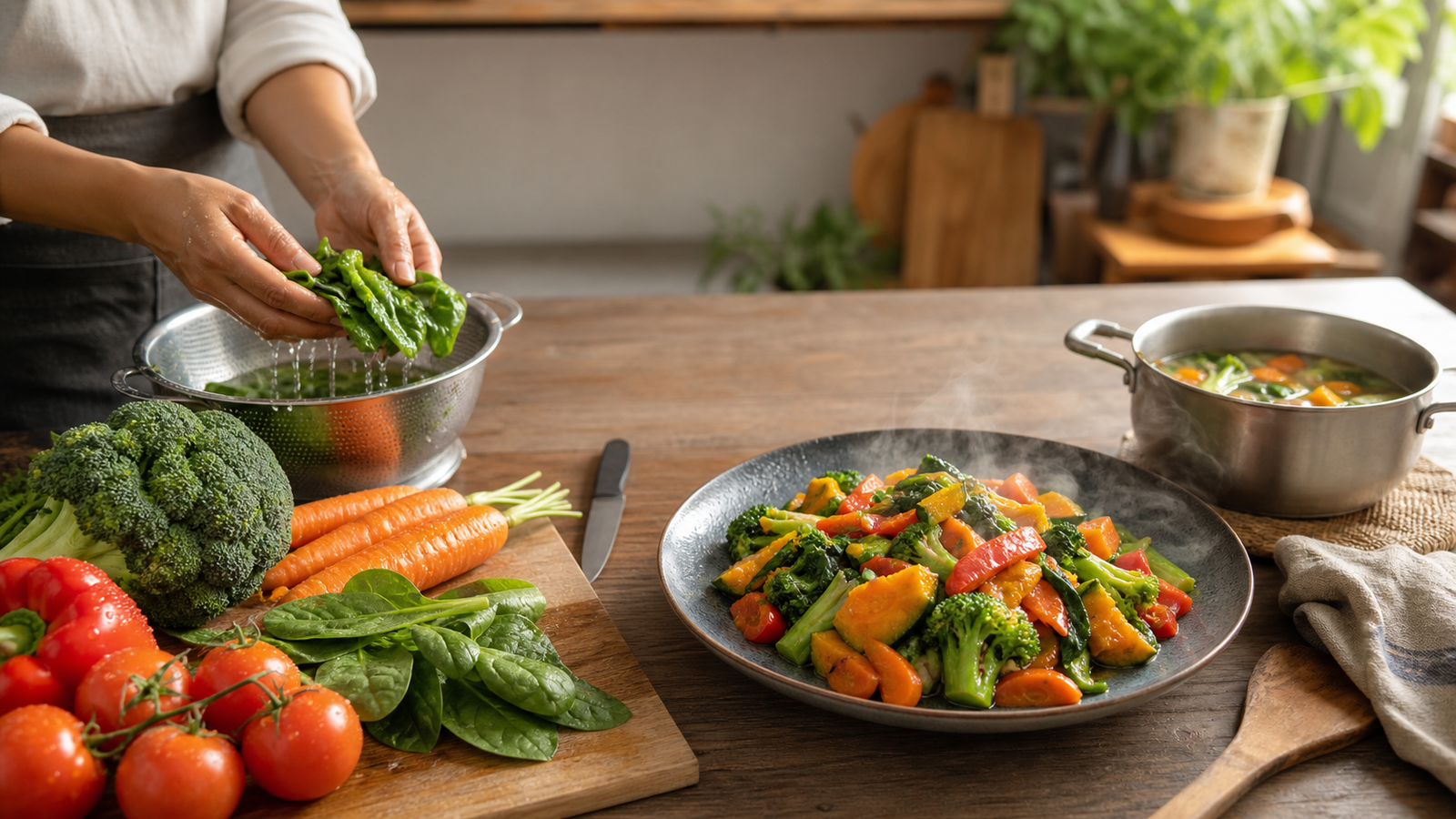
3. Wash produce using clean water and follow local food-safety guidance. The Singapore Food Agency recommends washing away soil, soaking leafy vegetables in fresh tap water for 15 minutes, and rinsing again. The US Food and Drug Administration recommends washing produce under running water and advises against using soap or household detergent.
4. Keep produce and its cutting board separate from raw meat, poultry, and seafood.
5. Refrigerate cut or ready-to-eat vegetables promptly and follow package instructions.
6. Check whether packaged salad is labelled ready-to-eat. Not every pre-packed vegetable is ready to eat without further preparation.
People who are pregnant, very young, older, or immunocompromised may need to be more cautious with raw produce, particularly raw sprouts. They should follow local health advice and choose cooked vegetables when appropriate.
Do you need to choose between raw and cooked vegetables?
For most people, a mixture is the easiest answer.
You might have raw cucumber and tomato at lunch, stir-fried leafy greens at dinner, papaya at breakfast, and pumpkin in soup. That variety gives you different foods, textures, nutrients, and preparation methods without turning every meal into a chemistry project.
For a busy workweek, try this simple rhythm:
- Keep one washed, ready-to-eat option available for convenience.
- Cook one or two larger batches of vegetables for weekday meals.
- Use quick methods such as steaming, microwaving, or stir-frying when time is short.
- Add colour across the week rather than forcing every colour into every meal.
- Prepare raw produce carefully and keep it away from raw animal foods.
The practical takeaway
Cooking changes vegetables, but “change” does not always mean “destroy.” Some nutrients decrease with heat or leach into water. Other compounds may become easier to release and absorb. Food safety, enjoyment, convenience, and the rest of the meal also matter.
Instead of asking whether raw or cooked vegetables are always better, ask a more useful question: am I eating a safe, varied mix of vegetables often enough to support my normal routine?
If you want a simpler way to build balanced meals across a busy week, download the free 7-Day Metabolic Reset Guide at https://vernlai.com/reset.
This article provides general wellness and food-safety education. People with medical conditions, weakened immunity, pregnancy-related concerns, or specific dietary needs should seek guidance from an appropriately qualified healthcare professional.
- Lee S, et al. “Effect of different cooking methods on the content of vitamins and true retention in selected vegetables.” Food Science and Biotechnology, 2018. https://pmc.ncbi.nlm.nih.gov/articles/PMC6049644/
- Yuan GF, et al. “Effects of different cooking methods on health-promoting compounds of broccoli.” Journal of Zhejiang University Science B, 2009. https://pmc.ncbi.nlm.nih.gov/articles/PMC2722699/
- Livny O, et al. “Beta-carotene bioavailability from differently processed carrot meals in human ileostomy volunteers.” European Journal of Nutrition, 2003. https://pubmed.ncbi.nlm.nih.gov/14673607/
- Singapore Food Agency. “Salad Safety: Risks of Raw Vegetables.” https://www.sfa.gov.sg/food-safety-tips/food-risk-concerns/risk-at-a-glance/salad-safety
- US Food and Drug Administration. “Selecting and Serving Produce Safely.” https://www.fda.gov/consumers/consumer-updates/selecting-and-serving-produce-safely
- US Centers for Disease Control and Prevention. “Preventing Food Poisoning.” https://www.cdc.gov/food-safety/prevention/