Your trousers feel tighter, but the scale has barely changed. Before deciding that you need a stricter diet, you might reach for a measuring tape. Where should it go: around your belly button, your narrowest point, or where your waistband sits?
For a health-related waist measurement, the position matters. Waist circumference can help assess abdominal fat and health risk, but it cannot diagnose diabetes or tell you exactly how much visceral fat you have. Here is a straightforward way to take a useful measurement at home.
How to measure your waist
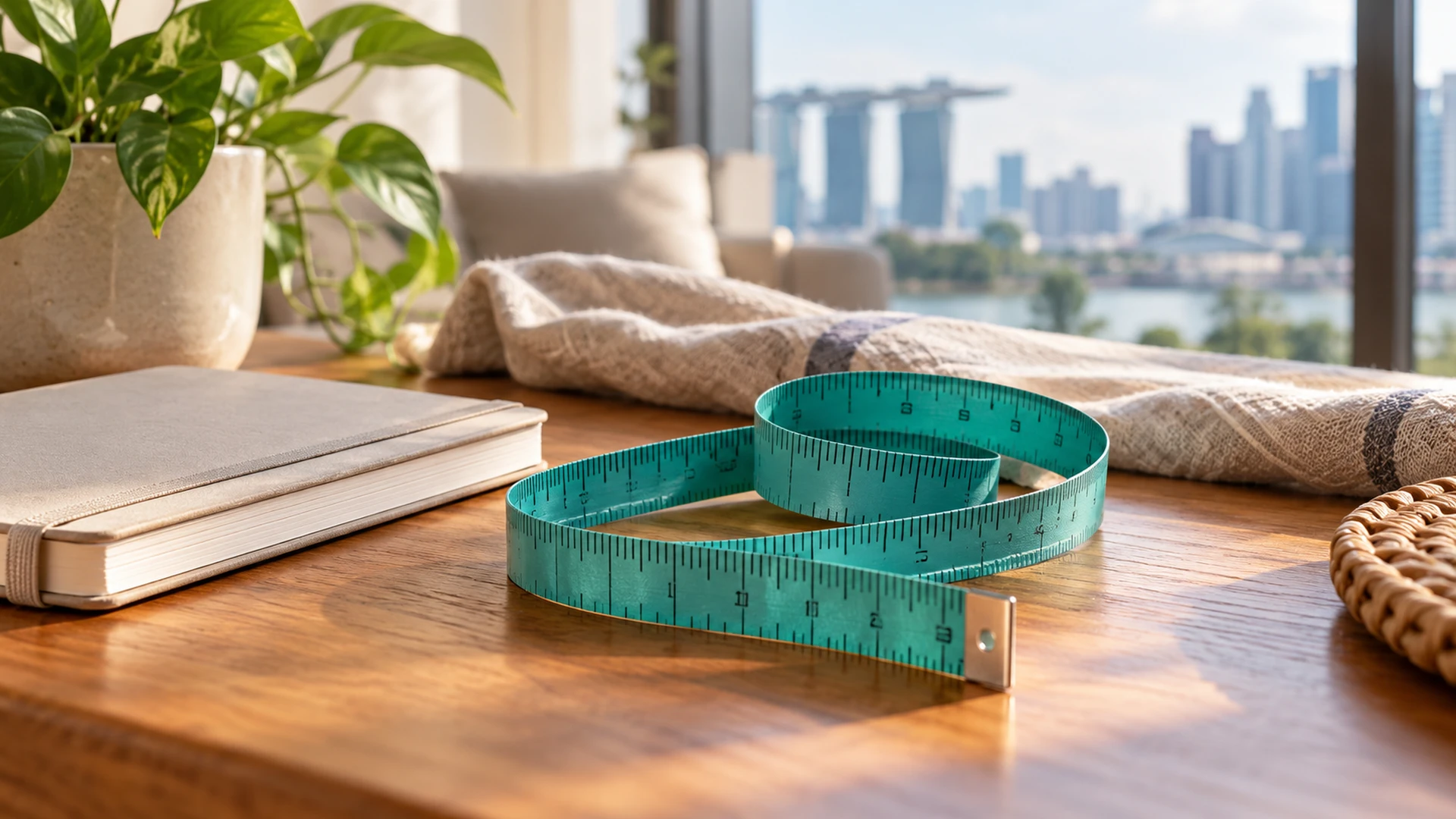
You need a flexible tape measure. HealthHub’s guidance places it around the midpoint between your lowest rib and the top of your hip bone, close to the skin, with the reading taken as you breathe out.
1. Find the landmarks. Feel for the bottom of your ribs and the top of your hip bones at your sides. Identify the point halfway between them. Do not assume your trouser waistband marks this point.
2. Position the tape. Stand upright with your abdomen relaxed. Wrap the tape around this midpoint, keeping it level all the way around. A mirror can help you check that it has not slipped down at the back.
3. Check the fit. Keep the tape snug against your skin without pulling it tight enough to press into it. Avoid measuring over bulky clothing or drawing your stomach in.
4. Breathe normally. Take the reading after a natural breath out. Write down the measurement in centimetres and the date. If the tape slipped or you are unsure of the position, reset it and try again.
What do Singapore’s waist thresholds mean?
HealthHub’s SingHealth guidance identifies a waist circumference of 80 cm or more for women and 90 cm or more for men as a marker of higher type 2 diabetes risk. These commonly used local thresholds for Asian adults help flag when a broader health review may be useful.
A measurement near a threshold is a reason to discuss your overall risk with a healthcare professional. It does not prove that you have a condition, and a result below it does not guarantee that your blood pressure, cholesterol or blood glucose are healthy.
What about keeping your waist below half your height?
The NHS also uses waist-to-height ratio alongside BMI for adults with a BMI below 35. Its simple guide is to keep waist circumference below half of height. For example, someone who is 160 cm tall has a ratio of 0.5 when their waist is 80 cm.
This is another screening guide, rather than a separate diagnosis. The NHS calculator excludes pregnancy and people with a diagnosed or suspected eating disorder, among other situations. Ask your healthcare professional what assessment is appropriate if standard measurements do not fit your circumstances.
Make comparisons fair
If you choose to track waist size, use the same measurement point and a similar routine each time. A reading taken with the tape tilted or pulled tighter is difficult to compare with an earlier one. Choose a review interval you can manage, such as every few weeks, rather than repeatedly checking during the day.
You can record the number alongside changes you are making to meals, sleep or activity. If the scale is confusing you too, read what daily weight changes can and cannot tell you.
Use the result to choose a useful next step
You do not have to respond to a measurement by removing rice, skipping meals or buying a supplement. If you are concerned about your risk, bring the reading to your GP, who can consider it with your history and other health checks. A home measurement is a starting point for that conversation.
For readers in perimenopause, our article on waist changes despite stable weight discusses that different question. This guide is about making the measurement itself more consistent.
If you would like to review everyday habits before choosing a change, start with the free 7-Day Metabolic Reset Guide. Use it as a planning resource, not a diagnostic test.
Sources
HealthHub: Do You Know All There Is To Know About Your Belly Fat?
HealthHub / SingHealth: Is diabetes one of the dangers of visceral fat?
NHS: Overweight and obesity in adults; waist-to-height ratio calculator.
East Lancashire Hospitals NHS Trust: Body measuring techniques.