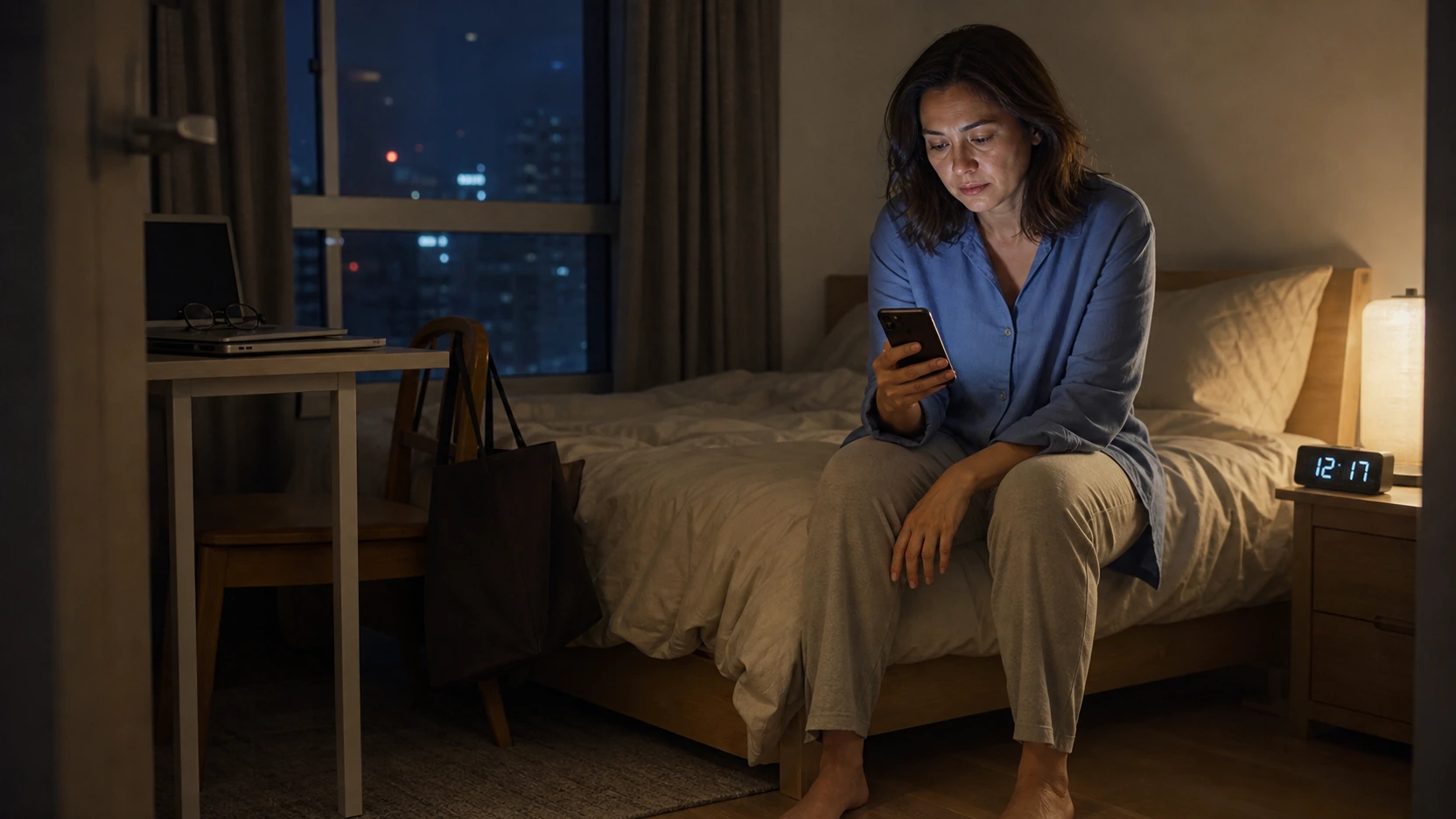
You finish the day tired. You know tomorrow will feel easier if you sleep soon. Yet once the house is quiet, you reach for your phone, start another episode or spend an hour doing nothing in particular.
If that sounds familiar, it may be bedtime procrastination: going to bed later than you intended even though nothing outside your control is keeping you awake. It is different from getting into bed and being unable to sleep. The issue begins before bedtime, when you keep postponing the decision to end the day.
For a busy adult, that delay is not always about poor discipline. Late evening may be the only part of the day that feels unclaimed by work, family and other responsibilities. Staying awake can feel like a way to hold on to a little personal time, even when your body is asking for rest.
Why Do You Delay Bedtime When You Are Already Tired?
Bedtime is a transition, and transitions can be surprisingly easy to resist. Closing the laptop does not necessarily close the working day in your mind. There may still be messages to check, decisions to replay and chores you did not finish.
Electronic leisure also makes it easy to remain awake without making a clear choice. One short video leads to the next. An episode ends with a reason to continue. The activity is pleasant enough to keep going, while bedtime feels like giving up the only free part of the day.
Recent research supports some of these observations, but it needs context. In a 2025 study from the National University of Singapore, 119 full-time university students reported their bedtime plans while wearable trackers recorded their sleep. Study or work and electronic leisure were common reasons for missing a planned bedtime. On days when participants made a bedtime plan, they went to bed slightly earlier and slept slightly longer on average.
That study found an association, not proof that making a plan will improve sleep for everyone. Its participants were also young university students, so the results should not be treated as a precise forecast for working women or older adults. Still, the pattern is useful: vague intentions such as “I should sleep earlier” are easier to overrun than a specific plan.
Stress Can Follow You Into the Evening
A 2026 systematic review and meta-analysis found that bedtime procrastination was associated with psychological distress, including perceived stress, among university students. The studies varied considerably, and an association does not show that stress directly causes someone to delay bedtime. The review also cannot tell us that every late night has a psychological explanation.
What it does suggest is that bedtime behaviour does not happen in isolation. If the entire day has felt demanding, the evening may become a place to decompress, avoid tomorrow for a while or reclaim a sense of choice.
This is why a strict “just put your phone away” rule can feel unrealistic. The phone may be part of the pattern, but it may also be providing entertainment, social contact or a mental break you did not get earlier.
A Small Experiment for Tonight
You do not need to create a perfect bedtime routine. Try treating tonight as an observation rather than a test of willpower.
1. Decide when the wind-down starts
Choose a realistic time to begin slowing down, not only the time you hope to be asleep. A bedtime plan works better when it includes the transition: finish the episode, plug in the phone, wash up and dim the lights.
Give the routine enough space to happen without rushing. The National Heart, Lung, and Blood Institute recommends using the hour before bed for quieter activities and keeping sleep and wake times reasonably consistent.
2. Notice what you are reluctant to stop
At the time you meant to wind down, ask one practical question: “What am I trying to keep right now?”
The answer may be entertainment, quiet, connection or simply time with no demands. Naming it helps you respond to the actual need. If you want quiet, ten intentional minutes with a book or music may feel more satisfying than forty minutes of distracted scrolling.
3. Replace part of the habit
Removing a screen leaves an empty space, so decide what will take its place. A small 2025 pilot trial involving new career starters tested approaches to reducing pre-sleep electronic-device use. The study was preliminary, but it supports exploring behavioural substitution rather than relying only on prohibition.
Your replacement could be stretching, preparing tomorrow’s clothes, listening to music or reading something that has a natural stopping point. Pick one option that fits your real evening rather than building an elaborate routine you will resent.
4. Protect a little personal time earlier
If late night is your only “me time,” bedtime will keep competing with something emotionally important. Look for a small pocket of choice earlier in the evening or day. Even ten minutes that belongs to you may reduce the feeling that going to bed ends your freedom.
This will not solve every sleep problem, and it is not a substitute for addressing an unmanageable workload or persistent sleep difficulty. It is simply a way to make the evening less dependent on last-minute self-control.
What If You Go to Bed but Cannot Sleep?
Bedtime procrastination describes delaying the act of going to bed. Insomnia and other sleep problems involve difficulty falling asleep, staying asleep or getting restorative sleep despite having the opportunity to do so. The two can overlap, but they are not interchangeable.
If you regularly make time for sleep but still struggle to fall asleep, wake frequently or feel that sleep problems are affecting daily life, that deserves a different conversation with a healthcare professional.
For tonight, keep the experiment small: choose a wind-down time, decide what activity will end, and prepare one quieter replacement. Then notice what made the transition easier or harder. The aim is not a flawless bedtime. It is to understand why you keep borrowing time from sleep and find a gentler way to give yourself the personal space you need.
For more practical ways to build steadier daily habits, download Vern Lai’s free 7-Day Metabolic Reset Guide at https://vernlai.com/reset.
- Pu Z, Ng ASC, Suh S, Chee MWL, Massar SAA. “Failing to plan: Bedtime planning, bedtime procrastination, and objective sleep in university students.” Sleep Medicine, 2025. https://pubmed.ncbi.nlm.nih.gov/40378648/
- Azeem MW, Sulaiman M, Haidong Z. “Bedtime procrastination and psychological distress in university students: a systematic review and meta-analysis of their association.” 2026. https://pubmed.ncbi.nlm.nih.gov/41867997/
- Hill VM, Ferguson SA, Rebar AL, Meaklim H, Vincent GE. “A randomised pilot trial for bedtime procrastination: Examining the efficacy and feasibility of the Reducing Evening Screen Time online intervention (REST-O).” Sleep Medicine, 2025. https://pubmed.ncbi.nlm.nih.gov/40081281/
- National Heart, Lung, and Blood Institute. “Healthy Sleep Habits.” https://www.nhlbi.nih.gov/health/sleep-deprivation/healthy-sleep-habits




One thought on “Why You Keep Delaying Bedtime Even When You’re Exhausted”